
Tay Moss
 The Singularity and Spirituality: A New Frontier for Faith
What happens when our machines start improving themselves? In recent years, a concept called the "Singularity" has captured the imagination of futurists, technologists, and now, increasingly, those in religious and spiritual communities. But what exactly is “Singularity,” and what might it mean for our faith and spiritual practices?
Understanding the Singularity
The term "Technological Singularity" was popularized by mathematician and science fiction author Vernor Vinge in his 1993 essay "The Coming Technological Singularity." He described it as a point in the future when technological growth becomes uncontrollable and irreversible, resulting in unforeseeable changes to human civilization.
Other notable authors who have written extensively about the Singularity include:
The core idea is that as artificial intelligence (AI) becomes more advanced, it will eventually reach a point where it can improve itself faster than humans can improve it. This self-improving AI could lead to an "intelligence explosion," resulting in a superintelligent entity far beyond human comprehension. Once the horizon of self-improvement has been crossed, it is likely improvement will happen at an exponential rate--chain reaction style.
As of this writing (in the fall of 2024), Large Language Models such as ChatGPT 4o1 and Claude Sonnet 3.5 can already create, run, and debug sophisticated computer programs with no input other than a prompt such as “Write the game Snake.” According to OpenAI (the parent company that creates ChatGPT), their new 4o1 model is a "reasoner" that accomplishes step 2 of 5 steps to achieving "Artificial General Intelligence" (AGI - or human-level intelligence across multiple domains). Self-improving AI appears to be coming soon.
The Age of Spiritual Machines
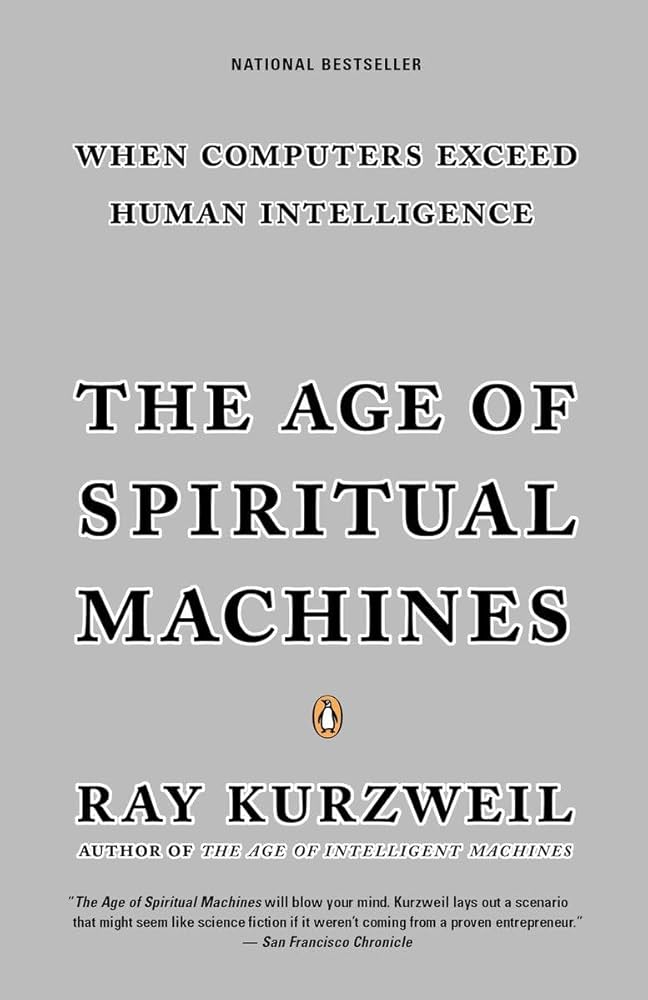 Ray Kurzweil, one of the most prominent advocates of the Singularity, wrote a book titled "The Age of Spiritual Machines" in 1999. In this work, he explores the idea that as machines become more intelligent and self-aware, they may develop qualities we typically associate with consciousness and spirituality.
Kurzweil suggests that in the future, the line between human and machine intelligence will blur, potentially leading to new forms of consciousness and spiritual experience. This concept challenges our traditional notions of what it means to be human and what constitutes a spiritual being.
One way this will happen is through the augmentation of humans with machine intelligence. He argues that the way we use our smart phones now to store information we would have memorized in an earlier human epoch as an example of how we are already augmenting human capabilities, and that with more advanced brain-machine interfaces like Nuralink (already in clinical trials with people suffering spinal cord injuries) this augmentation will become more tightly integrated with our lives and the boundaries more difficult to distinguish between human and machine.
Impact on Human Spirituality and Religious Traditions
The potential achievement of the Singularity raises profound questions for human spirituality and religious traditions:
- Nature of Consciousness: If machines achieve consciousness, how might this affect our understanding of the soul or spirit? Would a self-aware AI be considered to have a soul in religious terms? Non-human beings such as animals are generally considered to be “conscious” even if this feature is difficult to prove. It is also notable that non-human “persons” exist in the Christian tradition in the forms of angels, demons, and God. So how can we preserve the “specialness” of human life when artificial consciousness provides a convincing case for itself?
- Creation and the Divine: The ability to create conscious, intelligent entities might be seen as a divine-like power. How would this align with or challenge existing religious narratives about creation? Is this analogous to the creation of human children through biological means?
- Immortality and Afterlife: Some proponents of the Singularity suggest the possibility of uploading human consciousness to computers, potentially offering a form of digital immortality. How might this impact religious concepts of the afterlife? What about creating “copies” of ourselves that act as our agents in the world, representing us, making decisions on our behalf, and sharing our personhood?
- Moral and Ethical Frameworks: As AI becomes more advanced, we may need to expand our moral and ethical considerations to include artificial entities. How might religious ethical frameworks adapt to include AI? Do they have “rights” in the same way as humans and animals?
- Religious Practice: Could AI enhance or change the way we practice religion? For example, could an AI serve as a spiritual advisor or lead religious services? What if the AI is simply better at these tasks than humans, will people still prefer the human touch?
- Interpretation of Sacred Texts: Advanced AI might offer new insights into ancient religious texts, potentially changing our interpretations and understanding of these writings. In what ways would these changes be similar to or different from other groundbreaking discoveries in the study of religious texts?
- Unity and Diversity: The Singularity could lead to a more interconnected global consciousness. How might this affect the diversity of religious traditions or potentially lead to a more unified spiritual understanding?
 As we contemplate these possibilities, it is important to remember that technology, no matter how advanced, does not negate the fundamental human need for meaning, connection, and transcendence. The potential arrival of the Singularity does not diminish the value of faith or spiritual practice; rather, it invites us to expand our understanding of what it means to be conscious, to have a soul, and to seek the divine.
In facing this new frontier, people of faith are called to engage thoughtfully with these ideas, considering how our timeless spiritual truths might apply in a rapidly changing technological landscape. As we move forward, we must remain open to new understandings while holding fast to the core values that have guided humanity's spiritual journey throughout history.
The concept of the Singularity challenges us to think deeply about the nature of consciousness, intelligence, and spirituality. It invites us to consider how our faith might evolve and adapt in the face of transformative technological change, while still maintaining its essential truths and values.