
Ali Hayes
Lifelong Learning and the Changing Landscape of Theological Education
Guest blog by Helen Blier, Ph.D., Director of the Center for Lifelong Learning at Columbia Theological Seminary and President of ALLLM.
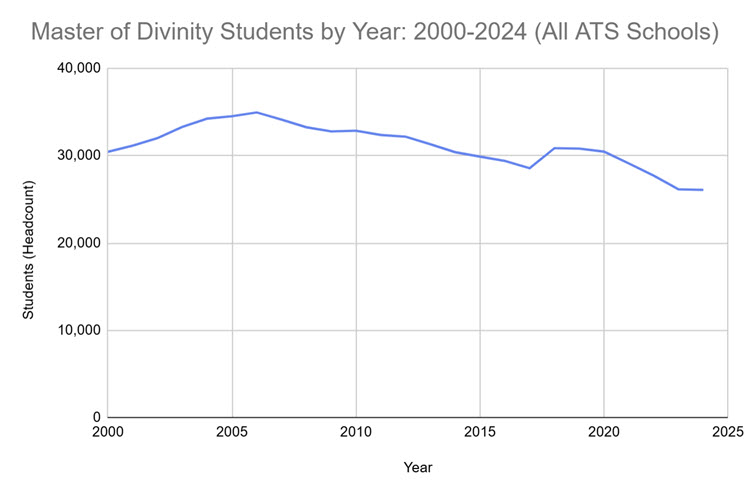 While formal degree programs in accredited
schools have overall seen a steady decline in enrollment since 2005, growth is
percolating in the form of lifelong learning and continuing education programs
for ministry.
While formal degree programs in accredited
schools have overall seen a steady decline in enrollment since 2005, growth is
percolating in the form of lifelong learning and continuing education programs
for ministry.
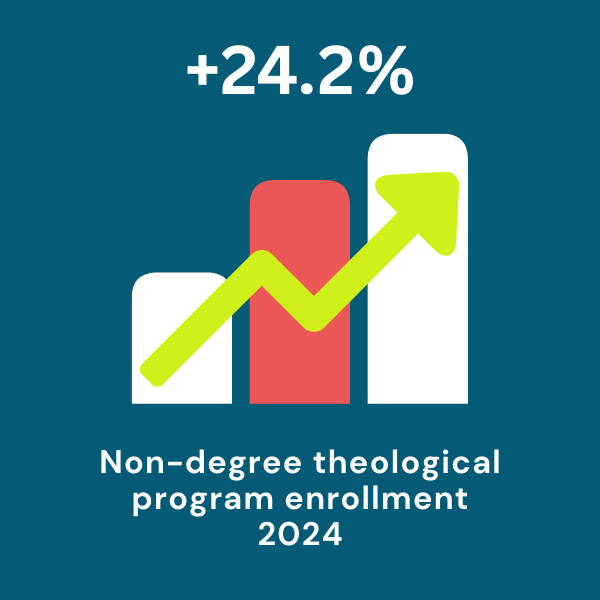
The numbers tell a compelling story. In 2024, The Association of Theological Schools, the accrediting body for schools of theology in North America, reported that enrollment in non-degree educational programs in member schools had risen a whopping 24.2% since the previous year (view the report here). This doesn’t include, of course, the many programs led by organizations not affiliated with ATS. You can bet that the real numbers are likely higher. This is great news, not just for those serving in ministry but also for the theological schools and denominations committed to nurturing and sustaining effective leaders.
 Recognizing this dramatic shift, the Association
of Leaders in Lifelong Learning for Ministry (ALLLM) set out to map the
landscape of these programs. Continuing education had already been identified
as one of five core pillars of support for ministry professionals, as noted by
Austin and Comeau in their landmark study, Caring for Clergy. However, good
information about these programs and their leaders had not been collected since
the late 90s. Noting this gap, ALLLM leadership had conducted a survey of
lifelong learning leaders and their work at the beginning of the pandemic,
which proved to be a watershed moment for so much of theological education and
congregational life. In early 2025, they sent out the survey again to see what
had changed. What did we discover?
Recognizing this dramatic shift, the Association
of Leaders in Lifelong Learning for Ministry (ALLLM) set out to map the
landscape of these programs. Continuing education had already been identified
as one of five core pillars of support for ministry professionals, as noted by
Austin and Comeau in their landmark study, Caring for Clergy. However, good
information about these programs and their leaders had not been collected since
the late 90s. Noting this gap, ALLLM leadership had conducted a survey of
lifelong learning leaders and their work at the beginning of the pandemic,
which proved to be a watershed moment for so much of theological education and
congregational life. In early 2025, they sent out the survey again to see what
had changed. What did we discover?
The context of the research is crucial. The five years since the original study have been exceptionally turbulent. The COVID-19 pandemic completely upended established patterns of education, church, and community. Since then, news feeds have been filled with stories of pastor attrition, continued congregational decline, and sociopolitical polarization, with churches often finding themselves to be hotspots of broader societal conflict. If ministry was challenging before, it's become even harder.
And if this wasn’t enough transition, denominations and theological schools were already wrestling with the effectiveness of existing models for preparing and sustaining ministers. For more than a century, the dominant approach for this preparation has been a “professionalization” model, much like those in medicine or law. This model has depended on (typically) a three-year degree that would sufficiently equip people to do pulpit ministry in traditional congregations. While this approach served its purpose for a time, it is no longer sufficient. Congregational life continues to go through transition with unprecedented speed. Ministers today need both enhanced skills and a nimble imagination to use those skills wisely as both “ministry” and “church” become more fluid.
In short, the current context for ministry is ripe for innovation and adaptive learning.
So, back to lifelong learning. What purpose does it serve, and who are the people leading these important efforts? The 2025 data, comprised of 57 survey responses from 140 identified lifelong learning program leaders in accredited theological schools, offer some compelling insights.
First off, the leaders of these programs are nimble and flexible, able to pivot and be responsive to the current needs of those who do ministry. This continues to be true from the initial 2020 results. In 2020, nearly all of the respondents reported pivoting swiftly to online and hybrid modalities, with many noting that their transition had happened more swiftly than the degree programs’ shifts. In the recent data, more than half reported continued evolution in program platforms and content since the pandemic. When asked to project what their programs will be like in five years, respondents used phrases like “more resources for those in ministry;” “partnerships and collaboration” with outside stakeholders; and “continued growth.”
A colleague once likened the Church’s attempt to change to an aircraft carrier trying to turn around in high seas; it would happen eventually, but the pace was ponderous at best. If that is the case with larger institutions, then lifelong learning programs and their leaders are more like sailboats, giving their host institutions the capacity to tack and pivot in response to prevailing winds.
 The leaders of these programs have a clear
sense of the value of their work and with that, a deep sense of vocation.
All but four respondents agreed or strongly agreed with the statement, “The
work that I do is aligned with my personal sense of vocation.” Similarly, all
but 5 respondents agreed that “Lifelong learning is the future of theological
and religious education.” As one
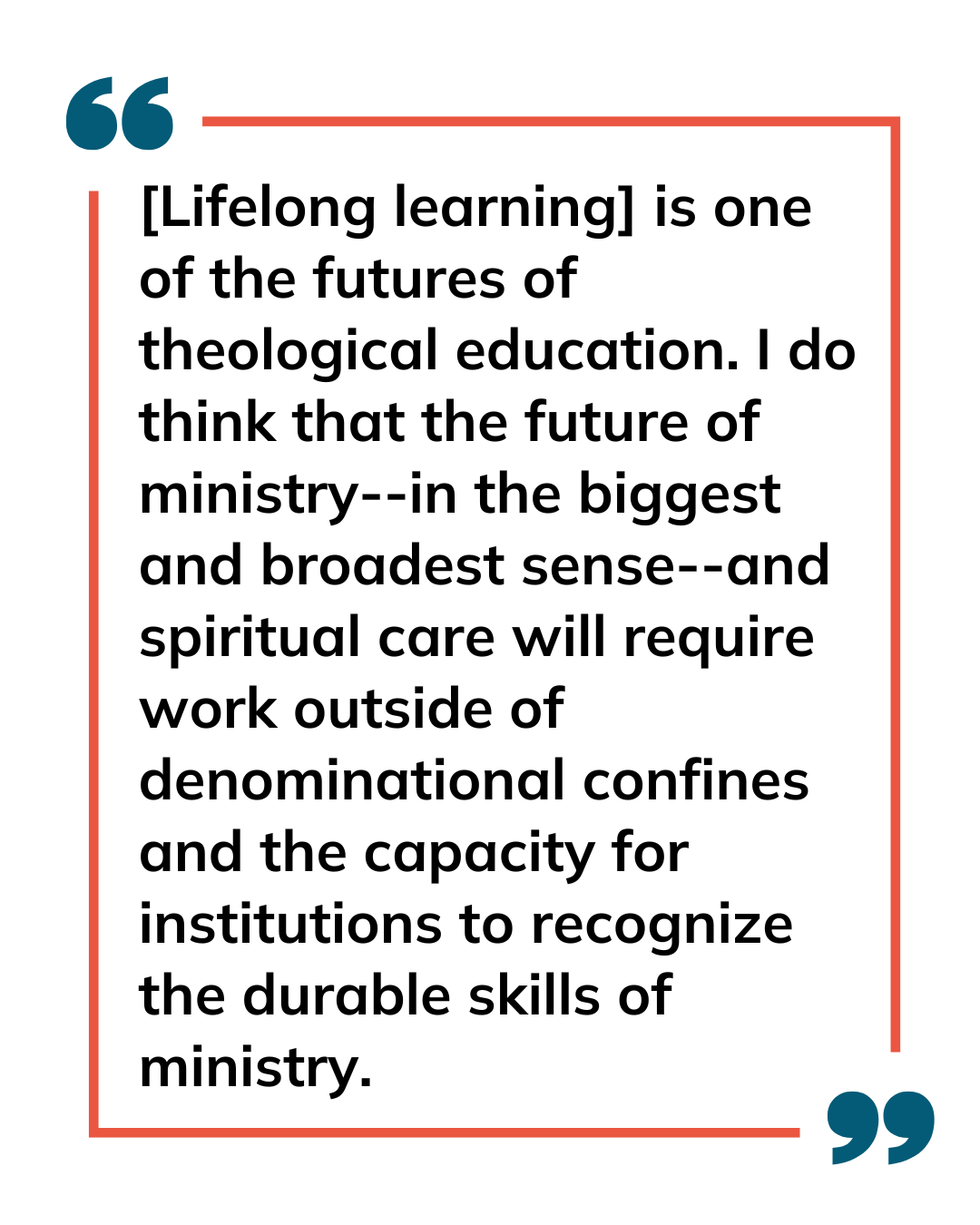
forward-looking director commented, “[Lifelong learning] is one of the futures
of theological education. I do think that the future of ministry--in the
biggest and broadest sense--and spiritual care will require work outside of
denominational confines and the capacity for institutions to recognize the
durable skills of ministry.”
The leaders of these programs have a clear
sense of the value of their work and with that, a deep sense of vocation.
All but four respondents agreed or strongly agreed with the statement, “The
work that I do is aligned with my personal sense of vocation.” Similarly, all
but 5 respondents agreed that “Lifelong learning is the future of theological
and religious education.” As one
forward-looking director commented, “[Lifelong learning] is one of the futures
of theological education. I do think that the future of ministry--in the
biggest and broadest sense--and spiritual care will require work outside of
denominational confines and the capacity for institutions to recognize the
durable skills of ministry.”
However, the survey also revealed a challenge. Most lifelong learning leaders report that their institutions have a long way to go in providing effective support for these programs. (Remember that aircraft carrier reference?) Even though the leaders of these programs and indeed the enrollment data point to these non-degree programs as being a crucial part of theological education’s future, truly supporting them will mean making hard decisions. Institutional infrastructures have been built over decades (centuries?) to support ministers and their preparation in a way that typically assumes traditional educational structures. For example, the median number of full-time staff for the lifelong learning programs surveyed was just 2.2, and 2/3 of the directors have additional responsibilities. However, more than half of the programs surveyed annually served over 250 participants with an average of 81 programs a year. By contrast, the median number of degree-seeking students in accredited theological programs is 155, according to the 2024 ATS Annual Data Tables. These students are supported by comparatively robust staff, faculty, and resources even as their numbers decline.
Supporting formational and non-traditional learning in new ways means a realignment of institutional priorities and resources. Ultimately, it means rethinking how we “do” theological education and the work it for which it prepares people. This requires uncoupling the intent (theological education and formation for ministry) from the means (degree programs, for example).
But I and my colleagues in ALLLM firmly believe this realignment is worth the effort. And for those of you lamenting the decline of churches, of seminaries, of the industry, I encourage you to look away from the empty tomb back to the garden. See where the growth is! That growth is in lifelong learning, demonstrating that there is still a need and appetite for theological education – and in new ways of being church and configuring ministry. And all of this can be supported by a robust and well-supported lifelong learning program.
Want to learn more about the lifelong learning research or become part of the ALLLM community? Visit www.ALLLM.org or contact Helen Blier at blierh@ctsnet.edu . Reports on the data will be published in Fall 2025!
 Author bio: Helen Blier has served in a number of roles, all of
which have been expressions of her basic curiosity in what makes people tick
and how they can live lives of vocational integrity in light of that. She currently
serves as the director of the Center for Lifelong Learning at Columbia
Theological Seminary in Decatur, GA and is the president of ALLLM, the
Association of Leaders for Lifelong Learning in Ministry. She is a resource
consultant for the In Trust Center for Theological Schools and regularly
presents and publishes on continuing education and lifelong learning. You can
reach her at blierh@ctsnet.edu .
Author bio: Helen Blier has served in a number of roles, all of
which have been expressions of her basic curiosity in what makes people tick
and how they can live lives of vocational integrity in light of that. She currently
serves as the director of the Center for Lifelong Learning at Columbia
Theological Seminary in Decatur, GA and is the president of ALLLM, the
Association of Leaders for Lifelong Learning in Ministry. She is a resource
consultant for the In Trust Center for Theological Schools and regularly
presents and publishes on continuing education and lifelong learning. You can
reach her at blierh@ctsnet.edu .