
Tay Moss
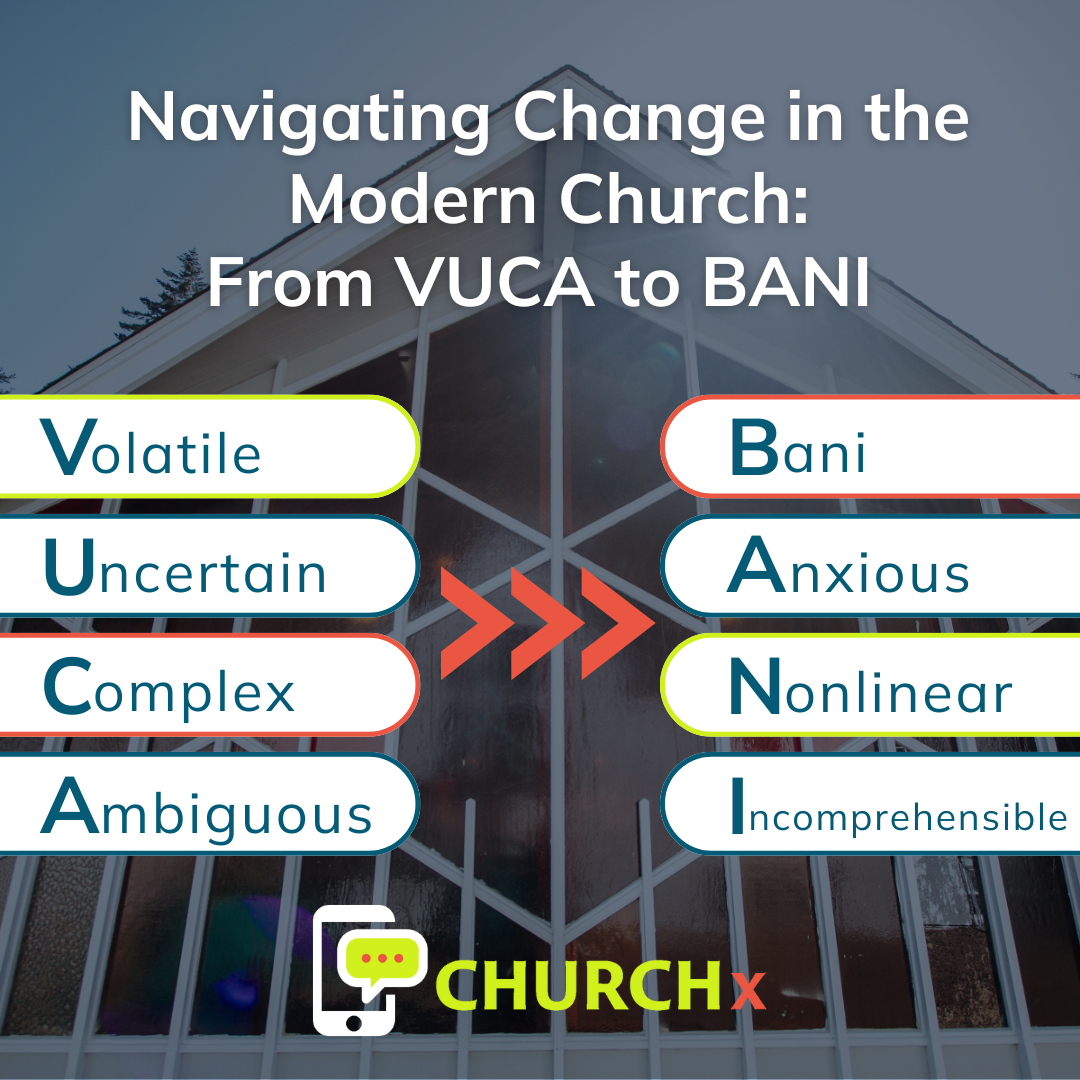
In this blog article I want to talk about how we characterize the current context of ministry. Tools like these frameworks help us to broaden our imagination and better cope with the challenges of ministry.
Introduction
The world of the church, particularly mainline denominations, has been experiencing unprecedented challenges and changes in recent years. To understand and respond to these shifts, it's crucial to examine the evolving frameworks used to describe our complex environment: from VUCA (Volatile, Uncertain, Complex, Ambiguous) to BANI (Brittle, Anxious, Nonlinear, Incomprehensible). This essay will explore how these concepts apply to the church's current situation, with a focus on the impact of COVID-19 and the acceleration of existing trends. Finally, we'll discuss strategies for ministry in this new landscape.
VUCA: The Initial Framework
The concept of VUCA, originally popularized by the U.S. Army War College, has been used since the late 1980s to describe the post-Cold War world. In the context of the church, VUCA can be applied as follows:
- Volatile: Rapid changes in church attendance and engagement.
- Uncertain: Unclear future for traditional religious institutions.
- Complex: Intersecting social, cultural, and technological factors affecting faith communities.
- Ambiguous: Blurred lines between spiritual practices and secular alternatives.
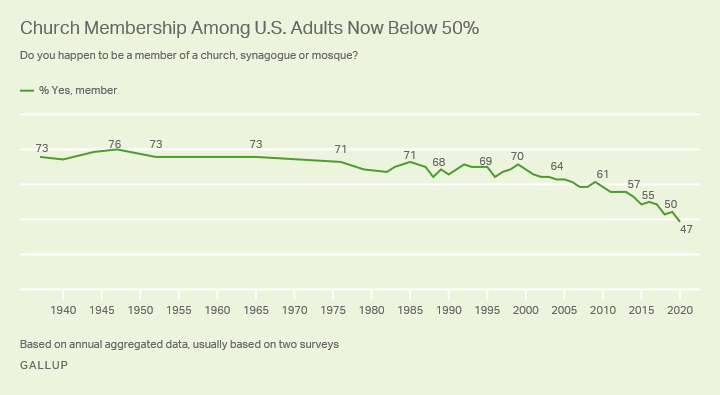
For years, mainline churches have grappled with these VUCA conditions, facing declining membership, shifting cultural values, and the challenge of remaining relevant in an increasingly secular society.
The Shift to BANI
As the pace of change accelerated, particularly in the wake of the COVID-19 pandemic, it appeared that “VUCA wasn’t VUCA enough!” So, a new framework emerged: BANI (Brittle, Anxious, Nonlinear, Incomprehensible). This concept, introduced by Jamais Cascio in 2020, offers a more nuanced understanding of our current reality:
- Brittle: Systems and institutions that appear strong but are vulnerable to sudden collapse.
- Anxious: Pervasive sense of fear and dread about the future.
- Nonlinear: Disproportionate, unpredictable cause-and-effect relationships.
- Incomprehensible: Situations that defy straightforward analysis or solution.
BANI and the Church in the Post-COVID Era
The COVID-19 pandemic served as a catalyst, intensifying the challenges already faced by mainline churches and accelerating their decline. The BANI framework helps us understand this new landscape: - Brittle: Many churches that relied heavily on in-person gatherings found themselves suddenly unable to function when lockdowns were imposed. This revealed the brittleness of traditional church models.
- Anxious: The pandemic heightened existing anxieties about the future of organized religion, with concerns about health, financial stability, and community cohesion intensifying the sense of unease.
- Nonlinear: Small changes in health policies or social norms led to dramatic shifts in church attendance and engagement. The rapid adoption of online services, for instance, had far-reaching and often unexpected consequences for congregations. For example, many congregations found themselves with a group of online followers who would be exclusively online participants in their community life. Another consequence was “virtual church shopping” in which congregants were diverse worship styles previously only available through in-person attendance. Exposing congregation members to diverse worship styles had the knock-on-affect of them suggesting improvements or changes to their home congregations.
- Incomprehensible: The long-term impacts of the pandemic on religious practice and spirituality remain difficult to predict or fully understand, leaving many church leaders feeling overwhelmed and uncertain about how to proceed.
 Applying BANI Principles to Ministry
Understanding the BANI framework can help church leaders develop more effective strategies for ministry in this challenging environment. Here are some approaches to consider:
1. Embracing Flexibility (Countering Brittleness):
- Develop hybrid models of worship that combine in-person and online elements. Examples:
- Interacting via chat with YouTube/Facebook audience
- Using Zoom to allow virtual antendees to do readings, prayers, or other worship roles
- Developing online-only offerings to compliment or augment in-person events
- Create decentralized ministry teams that can function independently if needed
- Empower lay people to make more decisions
- Diversify funding sources to reduce dependence on traditional giving models. Examples:
- Go-Fund Me campaigns on Social Media
- CanadaHelps campaigns
- Government grants for social assistance programs
2. Cultivating Resilience (Addressing Anxiety):
- Focus on mental health and well-being in pastoral care and community programs
- Cultivate partnerships with community mental health organizations
- Offer spaces for open dialogue about fears and uncertainties
- Don't rely on congregation members taking initiative, seek out opportunities, create environments
- Emphasize hope and community support in messaging and teachings
- Be specific about the supports available
3. Adaptive Planning (Navigating Nonlinearity):
- Implement agile planning processes that allow for quick pivots and experimentation
- Look to "Successive Approximation Model" and "SCRUM" as possible project management frameworks
- Encourage innovative approaches to ministry, even if they break from tradition
- Celebrate "unsuccessful successes" - learning experiences that expanded organizational capacity
- Develop scenarios and contingency plans for various possible futures
4. Fostering Understanding (Tackling Incomprehensibility):
- Invest in data analysis and interpretation to better understand congregational needs and trends. Examples
- Environics Demographic Reports
- Statista.Com Reports
- Count how many people walk/drive by your church
- Google Analtytics to understand how your website is used
- Interview local community stakeholders and leaders about your community and the neighbourhood
- Collaborate with other churches and organizations to share insights and resources
- Beyond the "Clericus" of local clergy - join Denominational, regional, and international groups online
- Keep up with reading recent books on church growth, missiology, and congregational development
- Provide educational opportunities for church leaders to enhance their ability to navigate complex systems
- Don't just attend webinars and events on these subjects, invite your leaders to them, as well
Conclusion
The shift from VUCA to BANI reflects the increasing complexity and unpredictability of our world, a reality that has profoundly impacted mainline churches. The COVID-19 pandemic has accelerated existing trends of decline and disruption, forcing religious institutions to confront their brittleness, address widespread anxiety, navigate nonlinear change, and grapple with incomprehensible challenges.
By embracing the principles of BANI and adopting strategies that prioritize flexibility, resilience, adaptivity, and understanding, churches can not only survive but potentially thrive in this new landscape. The path forward may be uncertain, but it also offers opportunities for innovation, deeper community connections, and a reimagining of what it means to be the church in the 21st century.